
Tank nozzles are essential for filling, withdrawal, venting, instrumentation, and safety systems. However, every nozzle also creates a penetration through the cryogenic tank insulation. These penetrations can become local thermal weak points and require careful attention during insulation design. Good nozzle design must control heat ingress, condensation, thermal movement, and insulation continuity.
Nozzles Create Thermal Bridges
A nozzle creates a direct metallic connection between different temperature zones. Because metals conduct heat much more effectively than insulation materials, heat can travel along the nozzle toward the cold vessel.
This local thermal bridge increases heat ingress and can create very low temperatures on external components. Designers must therefore consider nozzle geometry, material, length, and connection details when evaluating the overall thermal performance of the tank.
Maintaining Insulation Continuity
Cryogenic insulation performs best when it forms a continuous thermal barrier. Nozzles interrupt this barrier and create complex areas where insulation becomes more difficult to install correctly.
Poor insulation around a nozzle can leave gaps or areas with insufficient thickness. These local weaknesses increase heat transfer and can create cold spots on the external surface.
For perlite-insulated systems, designers must also ensure that expanded perlite can flow and distribute correctly around nozzle penetrations and surrounding structures.
Condensation and Ice Formation
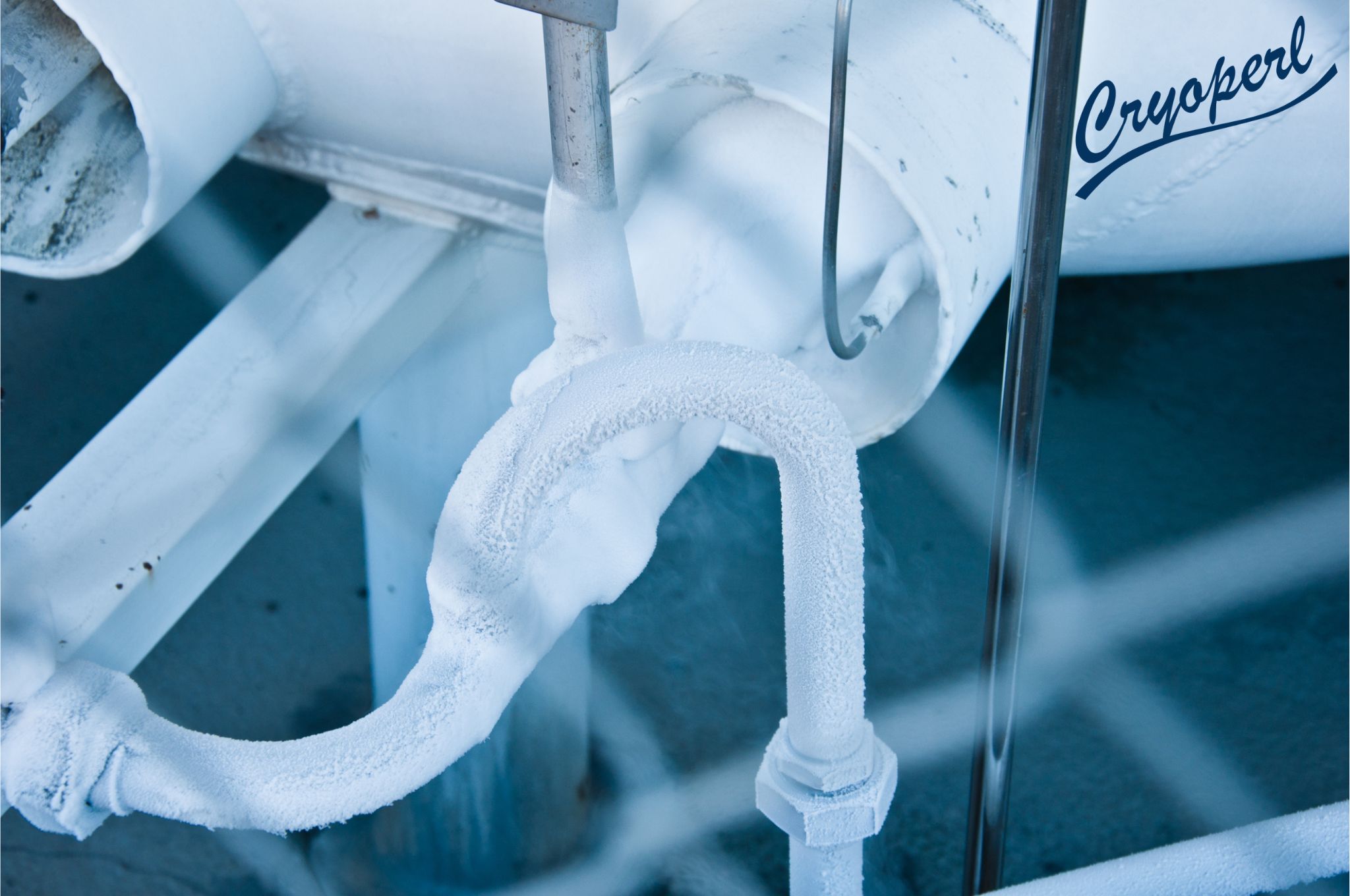
When external nozzle surfaces fall below the local dew point, atmospheric moisture starts to condense. If temperatures continue to decrease, this moisture can freeze and create ice around the nozzle.
Ice formation often indicates excessive heat transfer or insufficient insulation. Over time, repeated condensation and freezing can also introduce moisture into surrounding insulation and affect its performance.
Proper insulation termination and vapour sealing help control these risks.
Thermal Contraction and Movement
Cryogenic tanks experience significant thermal contraction during cooldown. The inner vessel, nozzles, piping, and insulation system do not necessarily contract at the same rate.
Nozzle connections must therefore accommodate movement without damaging the insulation or creating mechanical stress. Flexible insulation details and properly designed piping connections help maintain thermal integrity during cooldown, operation, and warm-up.
Nozzle Location Matters
Not all nozzles create the same thermal challenge. Their position, size, function, and operating temperature determine their impact on insulation performance.
Large process connections generally create greater thermal bridges than small instrument penetrations. Nozzles located near liquid level or permanently cold piping also require particular attention because they remain exposed to cryogenic temperatures during normal operation.
Engineers should therefore consider nozzle insulation as part of the overall tank design rather than treating each penetration as a secondary detail.
Conclusion
Tank nozzles may represent a relatively small part of a cryogenic storage system, but they can significantly influence insulation performance. They create thermal bridges, interrupt insulation continuity, and introduce potential areas for condensation, ice formation, and mechanical stress.
Careful nozzle design helps reduce local heat ingress and maintain reliable insulation throughout the life of the tank. In cryogenic engineering, controlling these small details often makes the difference between theoretical insulation performance and actual field performance.

